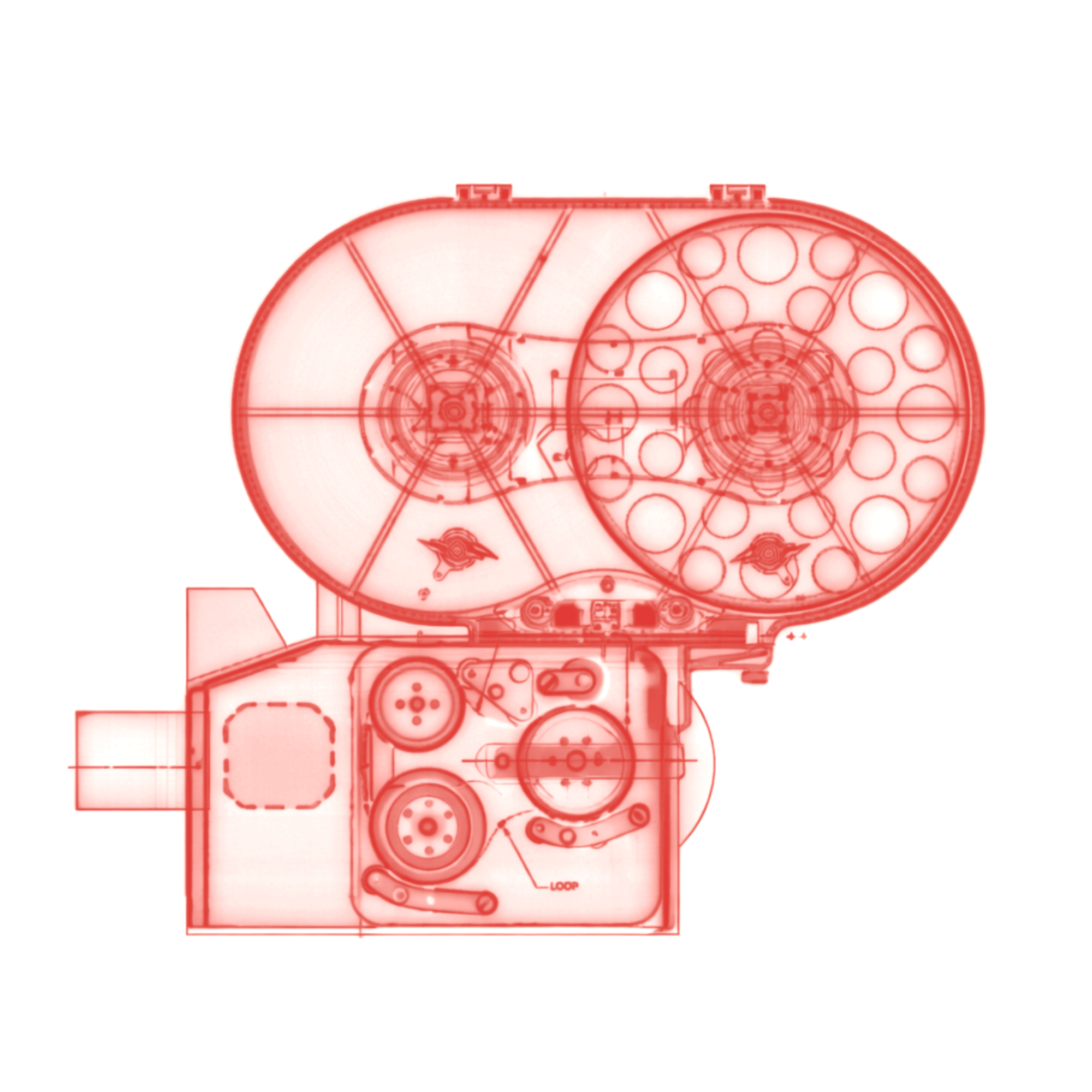
65mm High-Speed Cinematography
The hardest problem in cinema technology — and why it took a completely new camera to solve it.
65mm × 800fps
The largest negative. The fastest speed. For the first time ever.
What is 65mm high-speed cinematography?
High-speed cinematography — the art of capturing motion at frame rates far above the standard 24 fps — has been part of cinema since its earliest days. Slow motion reveals what the human eye cannot see: the spray of water in mid-air, the ripple of muscle in motion, the micro-expressions that tell a story between the frames.
For decades, this capability existed only on smaller film formats. 35mm rotary prism cameras could push beyond 3,000 fps. 16mm cameras could go even higher. But 65mm — the largest standard cinema negative, the one that delivers the most resolution, the deepest color, the most cinematic depth — was locked at standard speeds. The ARRIFLEX 765, the most advanced 65mm cinema camera ever made, tops out at 100 fps. No camera had ever been built to shoot high-speed on this format.
65mm high-speed cinematography is the convergence of these two worlds: the visual power of the largest cinema negative with the time-stretching capability of true slow motion. It means shooting at hundreds of frames per second on a frame over 52mm wide — capturing more visual information per second than any other motion picture system in existence.
52.5mm
Frame width on 65mm
800fps
K65K maximum speed
110Tiz
Image Bandwidth Index
Why high-speed on 65mm is the hardest problem in cinema
The physics of large-format film transport
A single frame of 65mm film is physically enormous compared to 35mm. It's wider, heavier, and has far more inertia. Every element of camera engineering — the gate, the transport, the registration, the optical path — must handle these forces while maintaining the sub-micron precision required for a sharp image.
At standard speed (24 fps), this is manageable. Cinema-grade 65mm cameras like the ARRIFLEX 765 use intermittent mechanisms — pulldown claws that stop the film, expose a frame, then advance to the next. The 765 can push this to 100 fps, which remains the highest speed any intermittent 65mm camera has achieved. But going significantly beyond that is a physical impossibility for this type of mechanism on this format.
Why intermittent mechanisms cannot go faster
An intermittent mechanism must accelerate the film from rest, move it exactly one frame, decelerate it to a complete stop, hold it perfectly still for exposure, and repeat — all within milliseconds. As frame rate increases, every one of these forces increases dramatically.
For 65mm, the problem is compounded. The mechanism required to handle the larger, heavier film strip would itself need to be so massive that it would destroy itself — both through its own kinetic energy and through mechanical fatigue. The film also physically travels faster through the gate at larger formats, multiplying the stresses further. This isn't an engineering challenge that can be solved with better materials or tighter tolerances. It's a fundamental physical limitation of the intermittent approach at this format size.
The same principle explains why even VistaVision — which runs standard 35mm film horizontally across 8 perforations — is limited in its high-speed capabilities. The larger frame means more film moving faster, more force, more inertia, more stress on every component.
The rotary prism: a different approach
The only way to achieve true high speed on large format is to eliminate the stop-start cycle entirely. Rotary prism technology does this by keeping the film in continuous motion. An optical prism — a precisely manufactured optical element — rotates inside the camera in synchronization with the film. As it rotates, it shifts the optical axis, effectively moving the projected image at exactly the same speed as the film passing through the gate. Instead of stopping the film to match the stationary world, the prism moves the image of the world to match the moving film.
What sounds simple to describe is extraordinarily complex to build. The prism's material, physical dimensions, and angular velocity must be precisely synchronized with film speed. The manufacturing tolerances are punishing: even tiny imperfections in the prism's geometry or the synchronization between prism rotation and film transport directly degrade the resulting image. The mathematical understanding of these optical systems is not ancient — the earliest high-speed cameras of this type were developed largely through trial and error, and the precision required for cinema-quality results on 65mm pushes the engineering to its absolute limits.
The core challenge
It's not just about making a camera run fast. It's about producing images stable enough and sharp enough for the world's largest screens, from a mechanism running at extreme speed on the world's largest cinema negative. Speed without image quality is meaningless.
Why film — even in the digital age?
A reasonable question: why build a new film camera at all? Digital high-speed cameras exist and offer extraordinary frame rates. Why not simply use digital for slow motion?
The 65mm cinema format has been defined by legendary cameras — the ARRIFLEX 765 and the Panavision System 65 — which have served filmmakers from Ron Howard to Christopher Nolan. These cameras established the visual language of large format cinema, but none of them could exceed 100 fps.
The large format is now experiencing a remarkable digital renaissance. New cameras like the ARRI ALEXA 265, the Blackmagic URSA Cine 17K 65, and the Fujifilm GFX ETERNA 55 are bringing 65mm-class sensors to more productions than ever before — making the format accessible, visible, and desirable again. This is great news for everyone working in large format, including K65K. The more productions discover what 65mm can do, the more demand there is for the one thing digital large format cannot offer: high-speed slow motion on photochemical film.
The answer to "why film?" lies in the physics of image capture. From VistaVision format upward, photochemical film records more visual information than a digital sensor can acquire in a single exposure. A 65mm negative, scanned at full resolution, contains an extraordinary density of data — color, detail, dynamic range, grain structure — that exceeds what any current digital cinema camera captures natively.
Film acquires this information photochemically, in the moment of exposure, through a molecular process that operates at a fundamentally different scale than electronic pixel capture. That photochemical record can then be digitized in post-production at whatever resolution the scanning technology allows — and as scanning technology improves, the same negative yields more data. The original capture is future-proof in a way that a fixed-resolution digital file is not.
For productions committed to the 65mm format — for its look, its depth, its emotional character — switching to digital for high-speed sequences means breaking the visual continuity of the film. K65K makes that compromise unnecessary.
A brief history of high-speed film cameras
High-speed cinematography has evolved through distinct eras, each defined by the formats and mechanisms available.
1940s–1960s
High-speed cameras developed for military and scientific applications — nuclear testing, ballistics, aerospace. Manufacturers including Photo-Sonics build cameras for 16mm, 35mm, and 70mm formats. The 70mm cameras are instrumentation tools using military-specification film stock (different perforations and pitch from 65mm cinema negative). None of these are designed for filmmaking.
1960s–1990s
High-speed technology is adapted for cinema and advertising on smaller formats. The Photo-Sonics 4B achieves over 3,000 fps on 35mm with a rotary prism. 16mm cameras push even higher. These become the workhorses for commercial slow motion and visual effects. Meanwhile, the 65mm cinema format gets its definitive camera — the ARRIFLEX 765 (1989), reaching 100 fps maximum. No high-speed camera is developed for 65mm.
2000s–2010s
The digital revolution transforms high-speed cinematography. Phantom and other electronic cameras offer extreme frame rates. Film-based high-speed cameras become rare; no new ones are manufactured. The 65mm format remains without any high-speed capability whatsoever.
2020s — K65K
The first high-speed camera ever built specifically for the 65mm cinema format. A new camera — not a conversion of military hardware, not an adaptation of an existing platform for a different purpose. Engineered for modern film production, with continuous development ongoing. The MkII, released in 2025, represents a major advancement in stability and optical performance.
From proven physics to a new camera
The K65K project began by studying rotary prism technology — the same fundamental physics proven in high-speed cameras since the mid-20th century, but on other formats. Existing hardware served as the testbed to validate a critical question: could this optical principle produce cinema-quality images on 65mm negative at extreme frame rates?
The physics worked. But producing a camera that could deliver those results reliably, on set, in production conditions, required far more than validation. The chassis and the fundamental synchronization between prism and film transport provided the starting point. Everything else — the electronics, the magazine system, the control interface, the power architecture, the optical path — was designed new, specifically for 65mm cinema production. And the work continues: K65K is an active development program, with each production cycle informing the next round of improvements.
A note on formats: 65mm is not 70mm
A common source of confusion: 65mm and 70mm are related but different formats. Both use film that is physically 65mm wide, but the perforation shape and pitch (the spacing between perforations) are different. 70mm refers to the exhibition print format — the extra 5mm accommodates magnetic sound tracks — as well as to military/scientific film stocks (Type I) with their own perforation standard.
High-speed cameras have existed for the 70mm military format since the 1960s. But these are instrumentation cameras — designed for test ranges, powered by industrial electricity, with no creative controls and no relevance to cinema production. They use different film stock with different perforations than the 65mm Type II negative used in motion picture origination.
K65K is built for 65mm cinema negative — the same format used by the ARRIFLEX 765, the same stock loaded by camera assistants on film sets worldwide. This is not a technicality. It's the difference between a scientific instrument and a cinematographic tool.
What K65K makes possible
When you build the first camera for a capability that never existed before, the question isn't "what does it improve?" — it's "what does it make possible for the first time?"
Full speed range: 1 to 800 fps
K65K doesn't just do high speed. It does every speed. From 1 fps for time-lapse to 24 fps for sync sound dialogue to 800 fps for extreme slow motion — in the same camera, the same setup, the same look. This isn't a specialty tool you bring out for one shot. It's a complete camera system.
Continuous ramping with 24 fps sync
Start a shot at sync speed for dialogue. Ramp up smoothly as the action intensifies. Push to maximum speed for the climax. Ramp back down. All in one continuous take. No other 65mm camera offers this capability — because no other 65mm camera can reach these speeds at all.
Battery-powered operation
K65K runs on a 48V battery system. No generator cables. Full mobility on set, on location, anywhere. This is a cinema tool designed for cinema workflows.
TirkyMag™: stop mid-take and recover film
In a traditional rotary prism camera, the film must accelerate to shooting speed before recording and decelerate after — wasting significant film on unusable tails. K65K's proprietary TirkyMag™ magazine system can stop mid-take (a first for any rotary prism camera) and reuses the tail film for the next take. This recovers up to 56 meters of film per take — roughly 2.5 seconds of footage at full speed, where the film travels at approximately 24 meters per second. On 65mm stock, that's a meaningful saving.
Modern control and monitoring
An ergonomic hand unit communicates directly with the camera's motherboard for precise speed control and real-time feedback. A parallax viewfinder with SDI output provides professional monitoring. Designed for cinematographers on modern sets.
Open lens mount
K65K uses an open-source mount philosophy with a standard Mamiya adapter (patent pending) and a proprietary internal focusing system enabling focal lengths from 50mm to 500mm with maximum stability.
65mm cameras: the speed landscape
| Capability | Standard 65mm cinema cameras | K65K |
|---|---|---|
| Maximum fps | 100 fps (ARRIFLEX 765) | 800 fps |
| Minimum fps | 2 fps | 1 fps |
| Speed control | Variable, narrow range | Continuous 1–800, full ramping |
| 24 fps sync sound | Yes | Yes |
| Mid-take stop | Yes (intermittent) | Yes (TirkyMag™ — with tail recovery) |
| Power | 24V cinema batteries | 48V battery |
| High-speed capability | None beyond 100 fps | The first and only |
| Mechanism | Intermittent (pulldown claw) | Rotary prism (continuous transport) |
| Status | 1989 design, still in service | Active development, MkII released 2025 |
Understanding image bandwidth
Frame rate alone doesn't tell the whole story. What matters is the total visual information flowing through the system — frame size multiplied by frame rate. A camera shooting extremely fast on a small format captures less information per second than K65K shooting at moderate speed on 65mm.
We created a metric to quantify this: the Image Bandwidth Index (IBI), measured in Tiz. It expresses the visual information throughput relative to standard 35mm cinema at 24 fps (= 1 Tiz).
K65K achieves 110 Tiz
In 12-perf format at 400 fps, K65K captures over 110 times the visual information of standard 35mm cinema per second — the highest image bandwidth of any motion picture camera system.
Who uses 65mm high-speed?
65mm high-speed cinematography is for productions where the image matters above all else — where the director and cinematographer demand the absolute maximum visual quality in every shot, including slow motion, without breaking format consistency.
Feature films
The 65mm format is experiencing a significant revival. Directors and cinematographers who choose 65mm for principal photography no longer need to switch formats for slow-motion sequences. K65K keeps the entire production on the same negative.
High-end commercials
Advertising productions that demand the ultimate in visual quality — automotive, luxury, beauty, sports — can achieve slow-motion effects on 65mm that are impossible with any other system.
Large-format exhibition
For productions destined for 65mm 15-perf exhibition or other large-format presentation, maintaining the native format in high-speed sequences is critical. Upscaling from smaller formats introduces visible artifacts on massive screens.
Visual effects
VFX plates shot on 65mm high-speed provide the maximum data for compositing — cleaner keys, better edge detail, more convincing integration.
Use them and shoot on what is officially Kodak's favourite camera.
— Lol Crawley ASC BSC, Academy Award–winning cinematographer (The Brutalist), speaking at Cinema Route 65
A film high-speed lab built around the camera
K65K is more than a camera. It's a complete high-speed film laboratory and production resource: the camera system, the proprietary scanning and stitching pipeline for non-standard frame formats, the technical expertise to integrate high-speed 65mm into any production workflow, and a facility equipped for testing, demonstration, and shooting.
Our proprietary software handles the unique challenges of K65K's 12-perf and 6-perf formats — frame stabilization, stitching, and precise alignment that standard scanning workflows can't accommodate. This isn't off-the-shelf post-production. It's a dedicated pipeline built specifically for the world's only 65mm high-speed camera.
Whether you need the camera on your set or you're exploring what 65mm high-speed can do for your project, K65K provides the complete chain — from initial consultation through final scanned frames.
K65K proprietary technology
TirkyMag™ magazine system
The first rotary prism magazine that stops mid-take and recovers tail film for the next take. 2,000 feet capacity. Up to 56 meters recovered per take. Learn more →
Image Bandwidth Index (IBI)
A new metric for comparing visual information throughput across any camera system. K65K achieves 110 Tiz. Learn more →
Internal focusing system
Patent-pending optical system enabling 50–500mm focal lengths with maximum stability on a rotary prism camera. Learn more →
Hand unit and motherboard control
Direct digital communication for precise speed control, real-time ramping, and instant feedback. Try the simulator →
Proprietary scanning pipeline
Dedicated software for frame stabilization and stitching of K65K's non-standard 12-perf and 6-perf formats.
Work with K65K
K65K is available for rental to cinema productions worldwide. We provide the camera, the technical support, the post-production pipeline, and the expertise to integrate 65mm high-speed into your workflow.
Book a demo or consultation
Contact us at [email protected] or visit the booking section to start a conversation about your project.
K65K® and its associated technologies including TirkyMag™, the internal focusing system, and the Image Bandwidth Index (IBI) are proprietary. Patent pending. © K65K. All rights reserved.